Choosing between a PEO and an ASO is one of the most important HR decisions a growing business can make. While both provide outsourced HR services, they differ significantly in how they support your organization, manage employment responsibilities, and deliver HR expertise.
If you’re comparing PEO vs. ASO, this guide explains the key differences and advantages and how to determine which HR outsourcing solution is the best fit for your business.
What Is the Difference Between a PEO and an ASO?
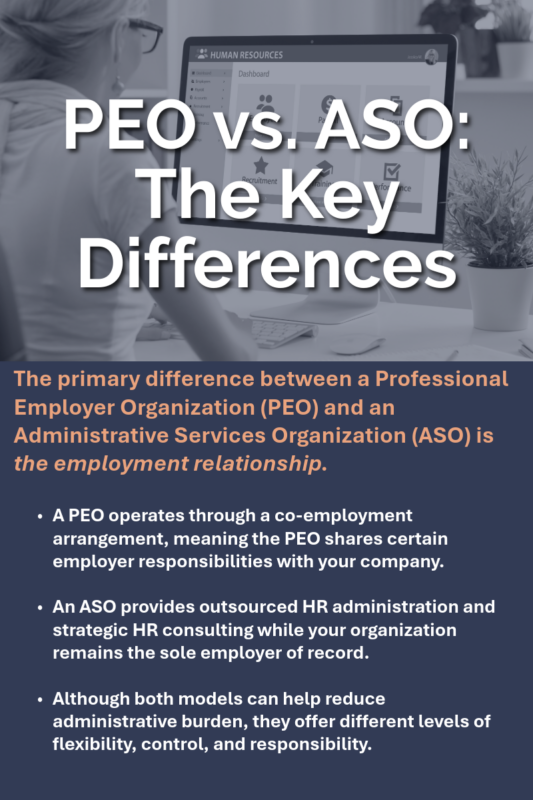
The primary difference between a Professional Employer Organization (PEO) and an Administrative Services Organization (ASO) is the employment relationship.
A PEO operates through a co-employment arrangement, meaning the PEO shares certain employer responsibilities with your company.
An ASO provides outsourced HR administration and strategic HR consulting while your organization remains the sole employer of record.
Although both models can help reduce administrative burden, they offer different levels of flexibility, control, and responsibility.
What Is a Professional Employer Organization (PEO)?
A Professional Employer Organization (PEO) delivers bundled HR services through a co-employment relationship.
Businesses often choose a PEO because it can provide access to larger employee benefit plans while managing many day-to-day HR administrative functions.
Typical PEO services include:
- Payroll processing
- Payroll tax administration
- Employee benefits administration
- Workers’ compensation management
- HR compliance support
- HR administration
- Risk management
Many startups and smaller employers find a PEO attractive because it provides an established HR infrastructure without hiring a full internal HR team.
What Is an Administrative Services Organization (ASO)?
An Administrative Services Organization (ASO) provides comprehensive HR support without becoming a co-employer.
Instead of sharing employer responsibilities, an ASO partners with your organization while allowing you to maintain complete ownership of employment decisions.
ASO services often include:
- Payroll administration
- HR consulting
- Compliance guidance
- Employee handbook development
- Policy creation
- Benefits administration support
- Recruiting assistance
- Leadership coaching
- Performance management
- Employee relations
This model provides the flexibility of outsourced HR while preserving your organization’s independence.
PEO vs. ASO: Side-by-Side Comparison
| Feature | PEO | ASO |
| Employer of record | Shared | Client company |
| Payroll taxes | Filed under PEO EIN | Filed under client EIN |
| Employee benefits | Typically through PEO plans | Employer chooses plans |
| Workers’ compensation | Often through PEO | Employer maintains coverage |
| HR support | Bundled | Customized |
| Employer control | Shared responsibilities | Full control |
When Should You Choose a PEO?
A PEO may be a good fit if your business:
- Is growing rapidly with limited HR staff
- Wants access to larger employee benefit plans
- Prefers a fully bundled HR solution
- Wants one provider managing payroll, benefits, and HR administration
For organizations looking for an all-in-one HR platform, a PEO can simplify many administrative responsibilities.
When Should You Choose an ASO?
An ASO is often the better choice when your organization wants strategic HR support while maintaining flexibility.
Many businesses prefer an ASO if they:
- Want to remain the sole employer of record
- Want to work with their own insurance broker
- Need strategic HR expertise
- Prefer customized HR solutions
- Want to keep existing payroll or HR technology
- Expect their HR needs to evolve over time
Because an ASO is not built around co-employment, organizations have greater flexibility in designing HR solutions that align with their business goals.
Can You Switch from a PEO to an ASO?
Yes.
Many businesses begin with a PEO and later transition to an ASO as they grow.
Organizations often make this change when they:
- Hire internal leadership
- Develop stronger HR processes
- Want greater flexibility
- Desire more control over benefits or payroll vendors
- Need strategic consulting instead of bundled administration
A carefully planned transition can help reduce disruptions to payroll, employee benefits, compliance, and daily operations.
Frequently Asked Questions
Is a PEO better than an ASO?
No. The right choice depends on your organization’s size, goals, HR resources, and desired level of control.
Does an ASO provide payroll services?
Yes. Many ASOs offer payroll administration while allowing your company to remain the employer of record.
Do employees work for the PEO?
No. Employees continue working for your company. However, under a PEO arrangement, certain employer responsibilities are shared through a co-employment relationship.
Is an ASO less expensive than a PEO?
Costs vary based on services provided. Because ASOs offer customizable support, organizations often pay only for the services they need, while PEOs typically bundle multiple services into a single pricing model.
Why Businesses Choose IDHR Consulting
At IDHR Consulting, we operate as an Administrative Services Organization (ASO) and our consultants partner with employers to provide:
- HR consulting
- Payroll administration
- HR compliance support
- Employee handbook development
- Recruiting support
- Leadership development
- Employee relations guidance
- Compensation strategy
- Workplace investigations
- Organizational development
We work alongside your team to build practical HR solutions that support long-term business success. Contact us today.