Article
As 2026 comes to an end, HR professionals are balancing year-end payroll, benefits administration, employee matters, and preparations for the coming year. With employment laws and compliance requirements constantly evolving, knowing where to focus can be challenging.
While a comprehensive HR compliance audit is valuable, the final months of the year may not be the most practical time to complete one. Instead, employers should prioritize immediate obligations, address known compliance concerns, and prepare for upcoming deadlines.
Here are five practical priorities to help your organization finish 2026 strong and prepare for 2027.
1. Identify Changes to Employment Law Taking Effect in 2027
State and local employment laws continue to evolve, particularly those involving minimum wage, paid leave, pay transparency, and employee protections.
Employers should review requirements in every state where employees work, including remote employees.
Action items:
- Confirm applicable minimum wage and exempt salary threshold changes.
- Identify new paid leave, pay transparency, or workplace notice requirements.
- Update payroll systems and policies before applicable changes take effect.
Key deadline: January 1, 2027, for laws effective on that date. Other changes may have different effective dates.
2. Complete Targeted Payroll and Classification Checks
Before finalizing year-end payroll, review employee information, taxable benefits, and outstanding adjustments to reduce reporting errors.
This is also an opportunity to address known wage and hour concerns, including employee misclassification and overtime calculations.
Action items:
- Verify employee names, addresses, and Social Security numbers.
- Review taxable fringe benefits and outstanding payroll corrections.
- Address known exempt/nonexempt and independent contractor classification concerns.
Key deadline: February 1, 2027. Employers generally must furnish 2026 Forms W-2 to employees and file them with the Social Security Administration by this date.
3. Review Hiring and Employment Documentation
Accurate personnel records and employment eligibility verification remain important compliance responsibilities.
Rather than attempting a complete personnel file audit before year-end, employers can review existing procedures and address known deficiencies.
Action items:
- Confirm Form I-9 completion and reverification procedures.
- Identify outstanding documentation issues requiring correction.
- Verify that confidential medical information is maintained separately from general personnel records, as required.
Key deadlines: Form I-9 Section 1 must generally be completed by the employee’s first day of employment, and Section 2 within three business days after employment begins. These are ongoing requirements, not year-end deadlines.
4. Prepare for Early 2027 Reporting Requirements
Several important reporting and posting obligations occur during the first quarter of the year. Employers should determine which requirements apply and confirm who is responsible for completing them.
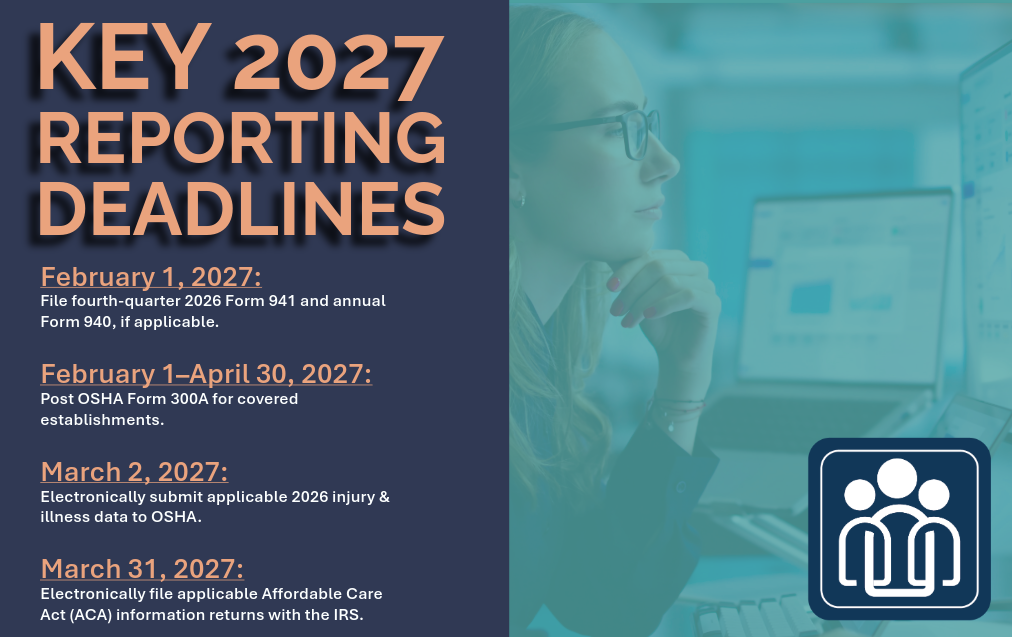
Key deadlines:
- February 1, 2027: File fourth-quarter 2026 Form 941 and annual Form 940, if applicable. Employers that timely deposited all required taxes may qualify for a February 10 filing deadline.
- February 1–April 30, 2027: Post OSHA Form 300A for covered establishments.
- March 2, 2027: Electronically submit applicable 2026 injury and illness data to OSHA.
- March 31, 2027: Electronically file applicable Affordable Care Act (ACA) information returns with the IRS.
Employers subject to ACA reporting should also confirm employee statement requirements, including whether they qualify to use an alternative website-notice process.
5. Establish a Manageable HR Compliance Plan for 2027
Not every compliance responsibility needs to be completed before December 31. Larger projects, including employee handbook updates, I-9 audits, wage and hour reviews, and manager training, can be scheduled throughout the coming year.
Action items:
- Identify outstanding compliance concerns and prioritize them based on risk.
- Assign responsibility for upcoming reporting deadlines and policy updates.
- Establish a calendar for periodic compliance reviews and manager training.
- Follow up on unresolved employee relations, leave, and accommodation matters.
Suggested internal deadline: December 31, 2026. This is a planning target rather than a legal requirement. Existing legal deadlines for individual matters still apply.
Finish the Year with a Practical Plan
Year-end HR compliance doesn’t have to mean completing an extensive audit or overhauling every policy. The goal is to identify immediate obligations, address known concerns, and establish a realistic plan for the year ahead.
By focusing on these five priorities, employers can reduce compliance risks, improve administrative efficiency, and enter 2027 better prepared.
At IDHR Consulting, we help organizations navigate changing employment laws, evaluate HR practices, and develop practical compliance solutions.
Need assistance preparing for 2027? Contact our team to learn how we can support your HR compliance efforts.
Summary Q&A:
Question 1: What are the Key year-end Priorities for HR compliance?
Answer:
- Identify changes to employment law taking effect in 2027
- Complete targeted payroll and classification checks
- Review hiring and employment documentation
- Prepare for early 2027 reporting requirements
- Establish a manageable HR compliance plan for 2027
Question 2: What actions do I need to take to establish a manageable HR compliance plan for 2027?
Answer:
- Identify outstanding compliance concerns and prioritize them based on risk.
- Assign responsibility for upcoming reporting deadlines and policy updates.
- Establish a calendar for periodic compliance reviews and manager training.
- Follow up on unresolved employee relations, leave, and accommodation matters.