A Helpful Q&A on Personal Leave Policy and Compliance
Employers often want to help when an employee is facing a difficult personal situation. When existing PTO or legally protected leave is unavailable or has been exhausted, offering an unpaid personal leave of absence may seem like a compassionate solution.
However, a loosely written personal leave policy can create compliance and employee-relations concerns. If approval decisions appear subjective, or if all requests are not handled in the same manner, employees may believe the policy is being applied unfairly or discriminatorily.
A well-designed personal leave policy allows employers to provide flexibility while establishing clear and consistent expectations.
Keep Personal Leave Separate From Legally Protected Leave
A personal leave policy should address circumstances that aren’t otherwise covered by the Family and Medical Leave Act (FMLA), the Americans with Disabilities Act (ADA), or applicable state and local leave laws.
Before considering a request for personal leave, employers should determine whether another law applies. The FMLA provides eligible employees of covered employers with job-protected leave for qualifying reasons. In addition, unpaid leave may be required as a reasonable accommodation under the ADA—even when an employee is ineligible under the employer’s standard leave policy.
This review should also occur before denying an extension or automatically treating an employee’s failure to return as a voluntary resignation.
Question: How Can I Establish a Consistent Approval Process at My Company?
Answer: Employee leave requests shouldn’t be decided informally by individual supervisors. The policy should identify:
- Who receives the request
- Who makes the final decision
- When senior leadership must be consulted
- What information or documentation may be required
- Which factors will be considered
An appropriate chain of approval might begin with the employee’s supervisor and end with the Human Resources Director. Requests exceeding a designated length could require additional executive review.
The leave policy should also state that decisions will be made consistently and on a nondiscriminatory, nonretaliatory basis.
Question: How Should We Define Eligibility and Leave Limits?
Answer: Employers should clearly establish who may request personal leave and how frequently it may be used. Eligibility may be based on employment status, completion of an introductory period, satisfactory job performance, and the needs of the business or department.
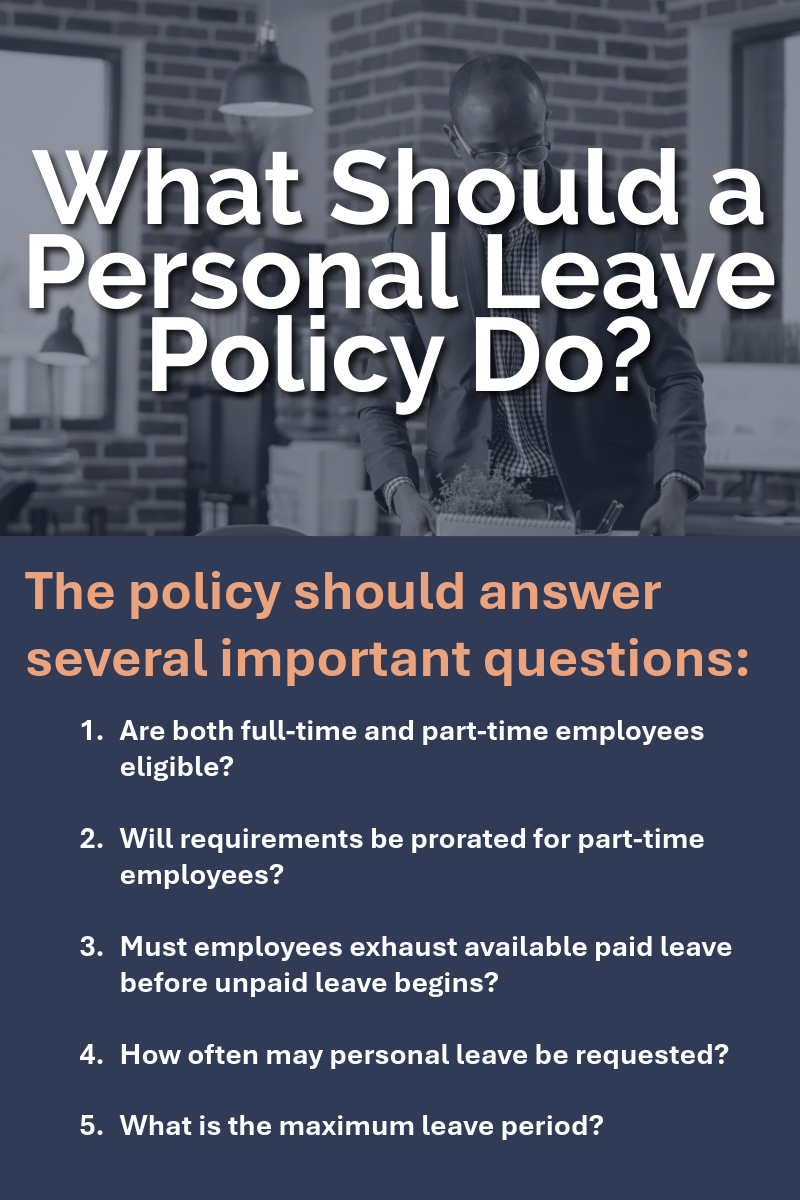
The policy should also answer several important questions:
- Are both full-time and part-time employees eligible?
- Will requirements be prorated for part-time employees?
- Must employees exhaust available paid leave before unpaid leave begins?
- How often may personal leave be requested?
- What is the maximum leave period?
Employers should think carefully before allowing personal leave lasting as long as 12 months. A shorter initial limit, with the possibility of an approved extension, may provide greater operational flexibility while still allowing requests to be evaluated on a case-by-case basis.
Question: How Do We Address Notice, Reinstatement, and Benefits?
Answer: The personal leave policy should require employees to submit requests in writing and provide advance notice when practical. It should also define an emergency and establish an alternative notice period for unexpected circumstances.
Return-to-work language should explain whether reinstatement is guaranteed. If employees may be returned to a “similar position,” the term should be consistently defined using factors such as pay grade, duties, hours, and location.
The policy should also explain:
- How insurance premiums will be collected
- When health coverage ends
- Whether PTO and seniority will continue to accrue
- How retirement, life, and disability benefits will be affected
- Under what circumstances may extensions and outside employment be considered and approved
A personal leave policy can help employers care for employees when no other leave program applies. The key is creating a clear framework that supports consistent decisions while accounting for applicable legal responsibilities.